

Does the leader need to be well-rounded? Must they be a good problem solver, inspiring, supportive, technical, and a therapist for team members, all at the same time?
I'm Roman, CTO at Cambri. I write High-Impact Engineering — a weekly newsletter about how product & engineering orgs work, and break, in their first 30 people. I've lived that passage as the executive; now I also advise founders going through it.
Some time ago, I attended a leadership course for Director+ folks. Overall, the curriculum was nice, and I enjoyed the insights and the interaction with other students. However, I didn’t agree with all the points in the curriculum.
One of these was exactly “becoming a well-rounded leader”.
Managers and leaders wear many hats on the same day. In the morning, you check the project status; in an hour, you have one-on-ones with team members; then you participate in a technical brainstorming session; then a roadmap discussion; then review CVs; then look into compliance stuff from the legal team. It can feel overwhelming, and not all of this might be enjoyable.
Some of this can be stressful.
For you.
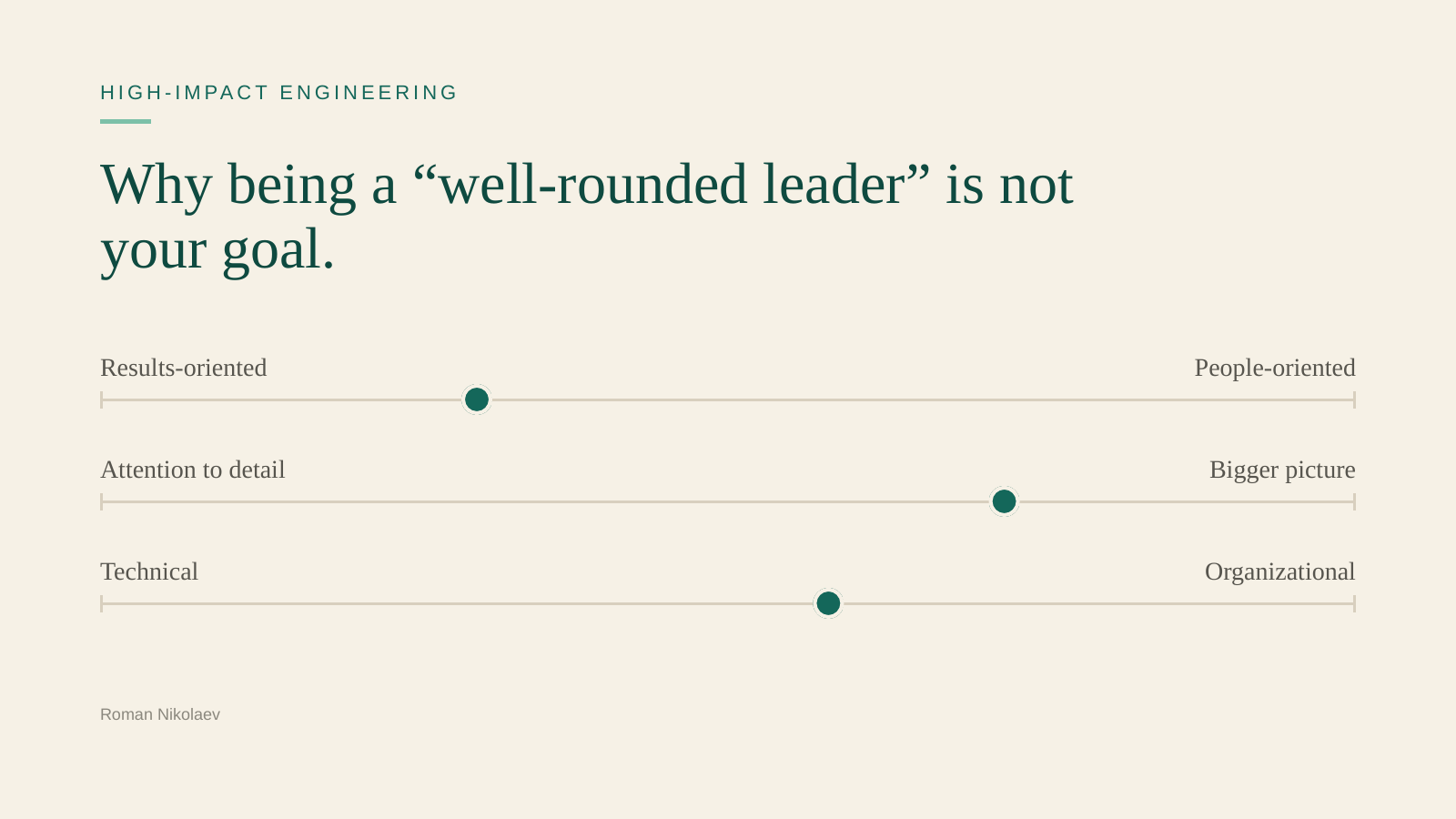
Energy axes
Here is the point: different types of people gain or drain energy from different things.
There are different axes along which we can position ourselves. From my observations, the most important are:
Results-oriented vs people-oriented
Attention to detail vs bigger picture
Technical vs organizational
Results-oriented people tend to view people as the means to an end. People-oriented ones want to keep people happy, sometimes at the cost of achieving goals.
Attention-to-detail people will, figuratively speaking, die over SOLID principles or missing corner cases, but they make very good specialists. Bigger-picture people are generalists and can sweep uncomfortable corner cases or overly technical details under the rug.
Technical leaders recharge close to the code: architecture, tooling, the craft itself. Organizational leaders get their energy from designing how the team works: structure, process, and growing people.
However, there are some extreme cases in each of these; most people fall somewhere on the spectrum, closer to one side. The closer you are to the extreme, the more draining the opposite side feels.
For example: “Why don’t these people just push through and get the project finished?” vs “The demands are unrealistic, the team is exhausted, and we need to push back on the deadline.”
Instinctively, I reach out to the first. It is a gut reaction I often need to catch and then ask myself whether I need to rebalance.
Which is your gut reaction?
Well-rounded team
Driving for results when you are a people-oriented person is exhausting. But you don’t need to do it by yourself.
Find or hire someone who augments you. If you are results-oriented, it is great to have a second-in-command who is people-oriented. They will keep you grounded. You can delegate some of the work that exhausts you to the person who actually enjoys doing it.
It doesn’t mean that you need to abdicate your responsibility in a certain aspect “because it is not my strength”. At the end of the day, you should hold yourself accountable, and most likely be held accountable by your peers and manager. You cannot just say you delegated team development to Alice and then blame her.
I would frame my approach this way: before developing yourself into a well-rounded leader, build a well-rounded team.
Hiring people just like yourself is not a good move. The team will have the same strengths and weaknesses as you. Identify the gap first.
Follow your day and notice what excites you, what activities you don’t mind, and what drains you.
These draining activities are exactly the gap you need to cover. Look around the team: who can help you with these activities? Maybe you can transfer someone to your team, or hire. When found, ask if they could help you, and decide how you manage the delegation, so that you can still be informed, accountable, and able to jump in when needed.
This approach both creates space for you to do something you are good at and allows your team members to practice doing more senior work.
You don’t need to break yourself, you transform
At that training, “becoming a well-rounded leader” felt like breaking myself into something I am not. My objection was a gut-level reaction, and it took me a while to understand it. The two paths are not really opposites. They have an order. Build the well-rounded team first. Then, working next to a person who is strong where you are weak, you learn from them: slowly, on the job, without breaking anything. Rounding does happen, but it comes as a side effect, not as a program.
P.S. I advise founders of product & engineering orgs in their first ~30 people. If your org’s gaps are all being covered by you personally — let’s talk.
If this was useful, subscribe to High-Impact Engineering for a new issue each week. New subscribers get The Manager’s Scoreboard, a free field guide to measure what actually matters as a manager and see where to grow next.
100% with you Roman, energy should be your indicator.
I particularly like your advice to develop a well-rounded team and a second in command that complements you. That's a great place to start.
Personally, when I started management I was much more on the left-hand side of your scale, as years have gone by I've moved along the spectrum.