

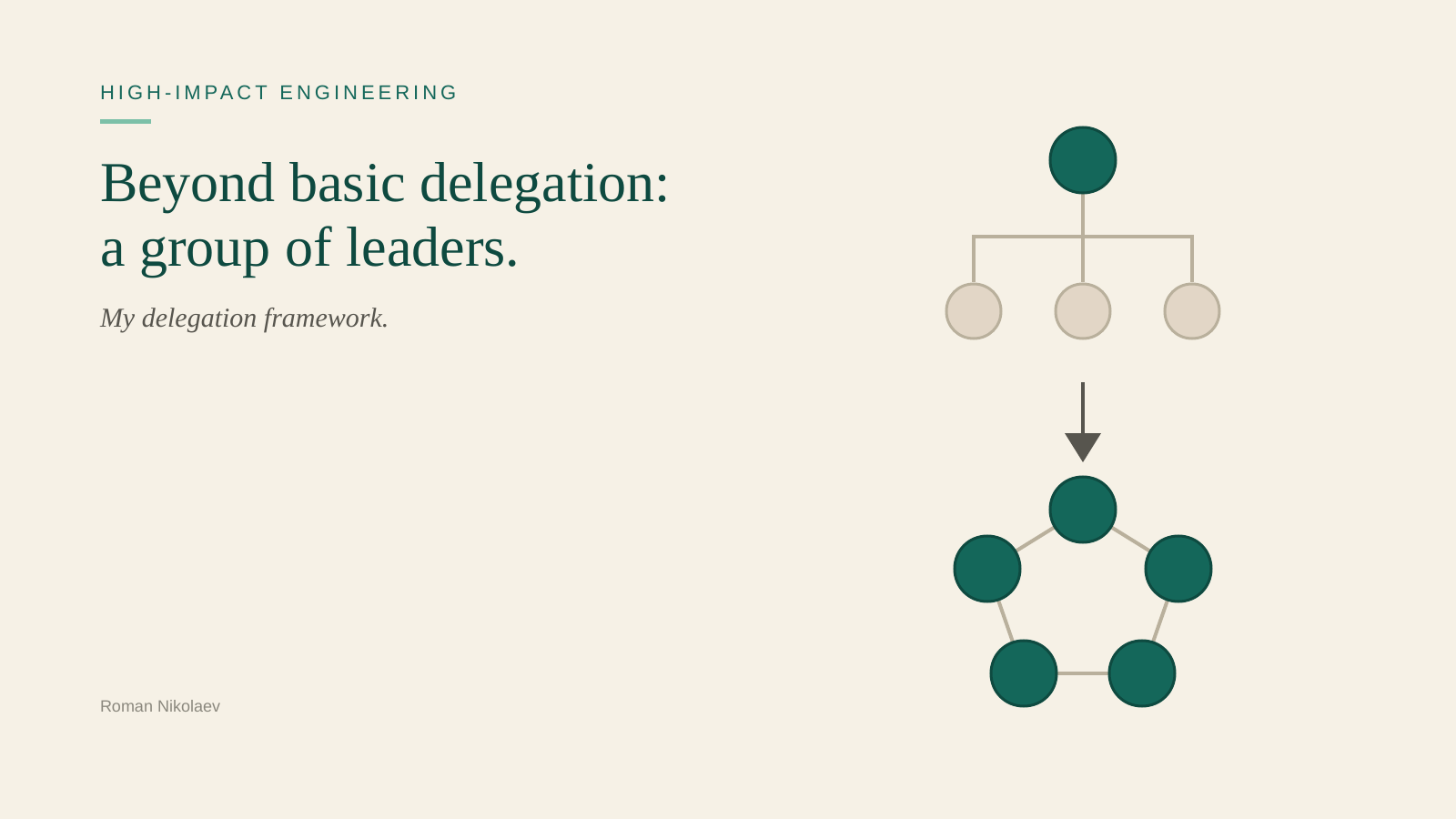
Without delegation, the manager will always be a firefighter. Every decision requires direct intervention. Every crisis needs the hero. It is nice to feel important and be the go-to person for everything, but at some point, the manager hits the wall. Too many tasks require their attention, and there is too little time. The team is blocked, and the manager is very stressed.
I’m Roman, CTO at Cambri. I write High-Impact Engineering — a weekly newsletter about how product & engineering orgs work, and break, in their first 30 people. I’ve lived that passage as an executive; now I also advise founders and engineering leaders going through it.
Personal stress is a great canary in the coal mine for the delegation problem. You might not see that the team is struggling because you are the bottleneck, but you will surely see it when your to-do list does not fit on one page of a notebook. In the evening after work, you are still ranking which task is the most urgent for tomorrow morning, and how it compares against the other three “first priorities”. Of course, we all have moments like this, but if it becomes the norm rather than the exception, it is time to start delegating more generously. Much more.
Not all types of delegation are equal.
Level 0: I delegate a task, and I watch over your shoulder.
Level 1: I delegate a task, and I don’t watch over your shoulder.
Level 2: I delegate the outcome, and I trust you to deliver.
Level 3: I delegate ownership, and you tell me what you need and where to go next.
Level 0
This level of delegation is reserved for junior people, or people who move into a completely new area and require the support of a more senior person. But it is not the level where you, as a manager, should spend a lot of your time. If a person stays at level 0 for several months, it is a signal that this person might not be a good fit for your team or organization. You can read more about this kind of situation here.
Level 1
I have a personal rule: if someone can do a task 80% as well as I could, I delegate without blinking an eye. At 80%, you can pretty much “delegate and forget”, no need to look over the shoulder.
Why not aim for 100%? It is nice and often possible, especially with more technical tasks, but often we just need to accept that perfection (from our point of view) is not the goal. The time freed up from the delegated task should go to the work only you can do, which has much bigger leverage for the team and for the business. Also, the person who starts at 80% will very likely get to 100%, and may end up doing the work better than you ever could. It is a win-win situation.
I did not learn this the easy way. My team leads told me “you do too much” several times in performance discussions before I believed them. When I finally started pushing things down, timelines slipped, and architectural mistakes were made that I would not have made. I wrote about that period here. The slippage was not a sign that delegation failed. It was the price of the team learning, and it paid itself back many times over.
Level 2
Level 2 means moving from delegating tasks to delegating outcomes. You move from “I need this presentation done by Wednesday, can you help me?” to “I want the number of P1 and P0 defects in production per quarter to stay under X, can you take care of it?” or “I want this epic delivered by date X, can you make sure it happens?”
Level 3
This is the highest level: you delegate a whole area and expect the person to drive success, or sometimes even define what success looks like. For example: “The performance of our system is not satisfactory. I want you to take care of it and be responsible for performance going forward. When you are ready, tell me what the plan is and how I can help.” This is the level that develops your team the most, and the one that drives the biggest business outcomes.
Seniority and delegation levels
It might sound counterintuitive, but the level of delegation does not depend on seniority; you just need to decide what to delegate to whom. A junior software engineer cannot own software architecture at level 2 or 3, but they can own the test automation strategy for a certain component. A senior engineer can own infrastructure architecture, security, or the relationship with a neighboring team.
The most satisfying moments for me as a manager have been seeing people take leadership, especially at level 3, not because they are told to, but because they want agency, development, trust, and a positive impact.
As managers, we should aim to move all our people to level 3, independently of their seniority, and find something each of them can own.
When people don't climb
Some people don’t want to own anything, or they say they want to, but nothing happens. You delegate, and there is no movement: not that week, not the next, not the one after. You talk with them, something starts moving, and then it dies again until the next nudge.
I don’t like working like this. I enjoy working most with high-agency people, but it is your call at the end of the day. Continuously operating at level 1 can be acceptable in your circumstances. Continuously operating at level 0 is a big red flag for me personally.
For founders and CTOs of small organizations, this becomes a hiring criterion. The ladder only works with people who want to climb it. For a small team, anyone who waits to be told what to do consumes the scarcest resource you have: your attention. Skills are much easier to train than agency and a sense of ownership.
A group of leaders
People develop, grow, and some move on, but I like to think that operating this way made their lives a little better and opened some opportunities, not only on the job: the chance to lead helps in other spheres of life too.
So be generous. Delegate, and trust your people.
The eventual state of well-executed delegation is a team where people own their areas, formally or informally. It turns a leader-and-followers structure into a group of leaders.
If this was useful, subscribe to High-Impact Engineering for a new issue each week. New subscribers get The Manager’s Scoreboard, a free field guide to measure what actually matters as a manager and see where to grow next.
Hi Roman, this is a very interesting approach. Thank you for sharing it.
I have a grew questions, if you don’t mind: Have you found it to be consistent over time? or have you found exceptions where you need to take a different approach?
I’m also curious where you draw the line between delegation and full role responsibility (making it a permanent part of a given role)? Is this something you’ve done?
There are also many leadership pearls hidden in this post, i’ll talk about them as notes :)